Secure Business Anywhere: Navigating the MPLS to SD-WAN and SASE Transition
One architecture that adapts to many scenarios
For decades, Multi-Protocol Label Switching (MPLS) was the backbone of enterprise networking — dedicated, predictable, and secure by design. But the way organizations operate has changed faster than that model can keep up with. Cloud adoption, the explosion of SaaS platforms, and a workforce that's no longer tied to a desk have all but rewritten the rules of network architecture.
We sat down withLaura Askew, co-founder of Criticalis, to talk through what's driving the shift toSD-WAN (Software Defined Wide Area Networks) and SASE (Secure Access Service Edge), what "secure business anywhere" really means, and what organizations need to know before making the leap.
Why This Shift Is Happening Now
Enterprise infrastructure has changed significantly over the past several years. Historically, organizations hosted applications on-premises or in data centers, and MPLS provided dedicated, secure point-to-point links between locations. That model made sense when everything connected back to a central location.
Three major shifts have disrupted it. First, the migration to cloud services. Second, the widespread adoption of SaaS platforms like Office 365 and Salesforce, hosted by third-party vendors rather than internally. And third, the dramatic rise in remote work, accelerated by COVID-19. Together, these changes eliminated the need for users to connect through a central point at all.
“The shift toward SASE is driven by three major trends: cloud migration, growth of SaaS services, and the rise of remote working.” -Laura Askew, co-founder, Criticalis.
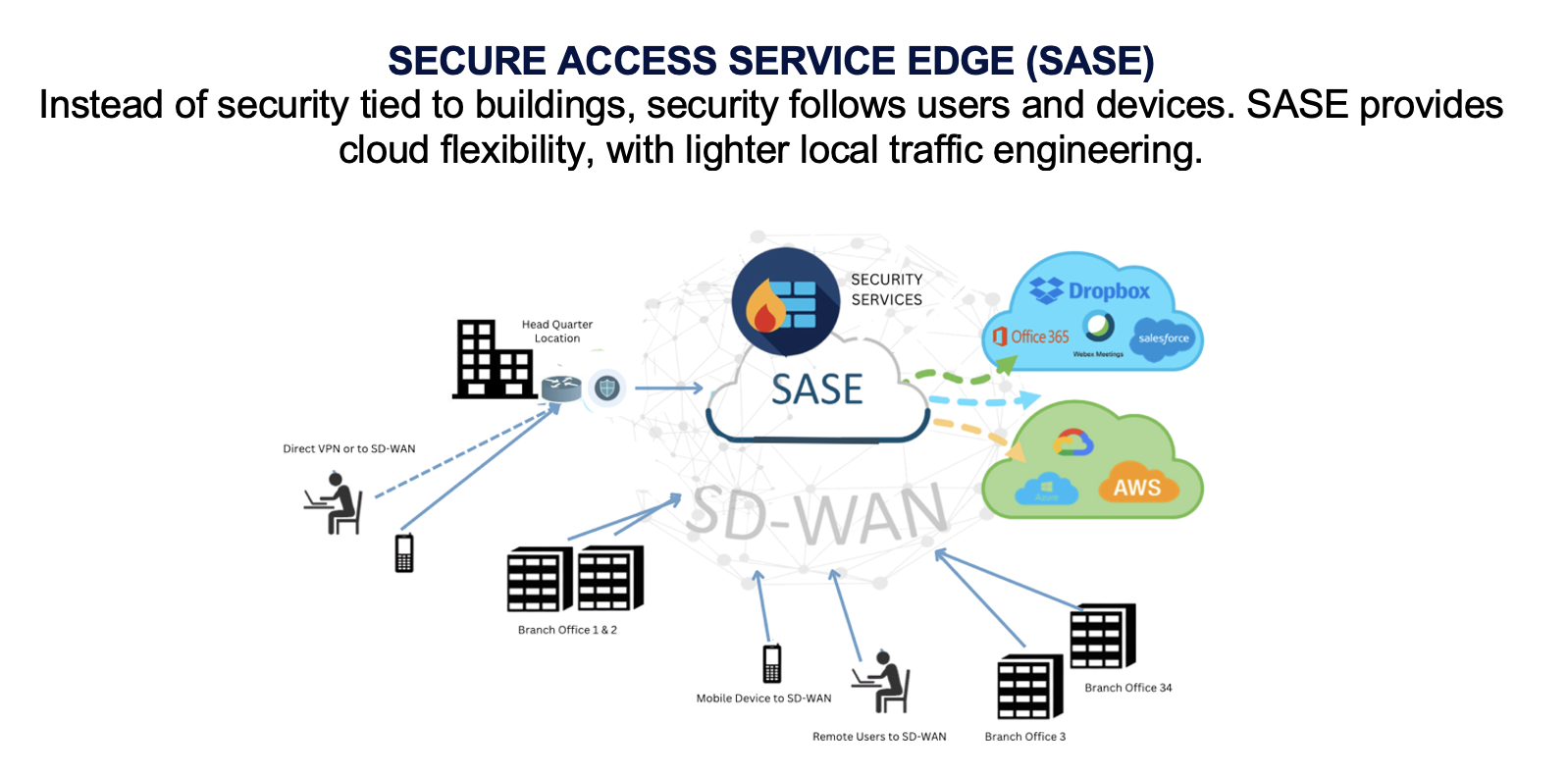
SASE is a cloud-native architecture that unifies SD-WAN with security functions like SWG, CASB, FWaaS, and ZTNA into one service.
By consolidating networking and security functions into a single, cloud-delivered service, SASE simplifies network management and enhances security.
The architecture supports the dynamic needs of modern organizations by providing scalable, unified access and protection for distributed environments.
---> In the MPLS era, security was built around secured point-to-point links between fixed locations — you knew exactly where your data was going and how. Today, connectivity looks completely different. Users access cloud-hosted resources from anywhere, including remote locations and even while traveling using technologies like Starlink.
SASE providers also offer globally distributed points of presence, allowing organizations to tunnel traffic over a shared backbone and emerge at local endpoints, wherever those happen to be. That eliminates the need to procure and manage dedicated lines, which offers a lot more flexibility. Something that would have seemed impractical five or ten years ago — like a fully mobile remote worker with no fixed connection point — is now not just architecturally feasible, but often the more logical approach given how infrastructure has evolved.
The MPLS-to-SD-WAN Transition
Think of this transition as a change in the nature and location of risk. For example, when you route traffic over a provider's backbone, you're introducing a dependency on that provider's infrastructure. It's similar to how a cloud outage at a major provider like AWS can cause downstream disruptions.
Organizations need to conduct thorough risk assessments to understand how risk is shifting, not simply whether risk exists. Modern SASE tools have matured a great deal and provide genuinely robust security functionality. The critical step is understanding what the new architecture actually looks like, and designing it deliberately, with a clear-eyed view of the risks that come with it.
“Organizations considering SASE transitions should begin with a thorough assessment of their architecture, requirements, and risk profile — before selecting technology.” -Laura Askew, co-founder, Criticalis
Organizations operating in environments where data confidentiality and integrity are absolutely paramount may need to exercise more caution. That said, those industries are typically already conducting rigorous risk assessments and have in-house security teams actively weighing these decisions.
For most industries, the transition can be made safely, provided the risk evaluation is thorough. In high-sensitivity environments, the primary concern really comes down to confidentiality risk.
Zero Trust + SASE
For decades, network security worked like a castle with a moat. Once you were inside the corporate network, plugged into the office, connected via VPN...you were trusted. That model doesn't hold up anymore, and it's exactly the gap Zero Trust and SASE were built to close.
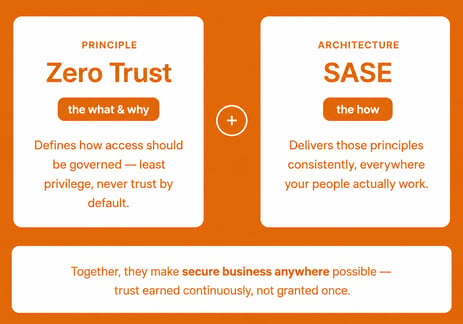
Zero Trust originated as a network architecture concept built on a simple principle: grant the least privilege necessary, and never trust by default. It started out fairly coarse — implemented through network segmentation, controlling which systems could talk to which. Over time, it's become far more granular, enabling user-level and application-level policy enforcement. A specific employee — let's call him Bob — can be granted access only to the resources required for his role, with read-only rather than read-write permissions where appropriate. That limits the "blast radius": the potential damage if Bob's account is ever compromised.
SASE is the architecture that makes that principle workable at scale. Instead of depending on which network the user happens to be accessing, the same security rules and policies follow the user wherever they are working, creating one consistent, unified framework for all users.
“Zero Trust and SASE are complementary. Zero Trust isn't a product you buy; it's a set of principles about how access should be governed. SASE is the delivery mechanism — the framework that actually enforces those principles consistently, across a distributed environment. You need both: a sound architecture to operate within, and clear policies governing what happens inside it.” - Laura Askew, co-founder, Criticalis
Neither fully replaces the other — together, they're what makes "secure business anywhere" actually possible.
Practical Guidance for IT and Security Leaders - the first 90 days
Where do organizations begin to evaluate a transition? Start by clearly defining what you're actually trying to achieve. That means a thorough assessment of your current infrastructure — how many sites you have and what each one looks like, what applications and connectivity are genuinely needed at each location, and how users actually traverse the network day to day.
Under a SASE model, smaller remote sites may only need a stripped-down firewall that breaks out to a provider's points of presence, while larger sites may still warrant traditional firewalls. This is exactly where a partner like Technium adds value — helping map the existing architecture, identifying where SASE is genuinely a good fit, designing how the overall environment will interact, and phasing in complex rollouts to minimize risk. The goal is to understand, and plan for, the full picture before selecting or deploying any technology.
Grounding the process in requirements and risk, rather than getting drawn in by whichever product has the most features, is the most important first step you can take.
Step-by-Step Assessment Plan
Step 1: Leave Technology Out of It — For Now Start with strategy, not products. Define your goal before evaluating anything else.
Step 2: Assess Your Current Infrastructure Map your sites, what happens at each one, what connectivity is needed, and how users traverse the network.
Step 3: Build Out Your Requirements Separate non-negotiables from nice-to-haves. This keeps your evaluation grounded and vendor-neutral.
Step 4: Understand How Risk Is Shifting A transition changes the nature and location of risk — not just whether it exists. Know what you're accepting.
Step 5: Right-Size the Solution for Each Location Smaller sites may need only a stripped-down firewall. Larger sites may still warrant traditional infrastructure. Design accordingly.
Step 6: Evaluate Technology Last Few tools cover every piece of the puzzle. Let your requirements lead the selection — not the other way around.
How do you know if this new architecture is working? Success metrics depend on the organization's primary goals going in. Common objectives include cost reduction — eliminating MPLS costs being the obvious one — architecture simplification, like consolidating firewall and MPLS functions into a single point of presence, improved user access and responsiveness, and ease of provisioning and ongoing user management. At the end of the day, the key question is whether the transition was implemented seamlessly, and whether users can get what they need without friction.
Looking Ahead
Modern networks require modern architectures. Moving beyond MPLS isn’t just upgrading connectivity, it’s aligning your network infrastructure to how your business actually operates. The shift from perimeter-based trust to continuous, identity-based verification is paramount to the “secure business anywhere” mindset.
“SASE is widely regarded as a sound, logical long-term direction — especially for organizations with multiple sites, remote workforces, and cloud-heavy environments. It's a direction I think a lot of companies are going to continue moving toward.” -Michael Joseph, CEO, Technium
The shift from MPLS to SD-WAN and SASE isn't just a technology upgrade — it's a fundamental rethinking of where trust lives in your network. Instead of relying on fixed, dedicated links between known locations, organizations are learning to verify continuously, govern access granularly, and extend security to wherever people actually work.
This isn't a transition to rush into for the sake of keeping up with the industry. It's one to approach deliberately — starting with a clear-eyed assessment of your architecture, requirements, and risk tolerance, long before any technology decisions are made. For organizations with multiple sites, distributed workforces, or cloud-heavy environments, SASE isn't just a trend to watch. It's a sound, logical direction — and one that genuinely makes "secure business anywhere" possible. ⊥
Interested in assessing whether SASE is the right fit for your organization?Reach out to the experienced team at Technium to start the conversation.
We secure and maintain your diverse network landscape, wherever it roams. Designing, implementing & managing high-performance, highly available, compliant networks for critical industries.
Since 1999, Technium has been a leading provider of uniform, predictable, secure & highly available end-to-end connectivity business outcomes for companies of all sizes, from Fortune 200 Enterprise to small business.
Specialty secure network solutions tailored to your business needs.
Service provider mindset, engineering approach
Complex, global network designs
24x7 operational support
Committed & purpose-built to be an extension of your team & a true business partner
Technium builds and operates exceptional networks.
Criticalis was founded in 2017 by two security experts – former colleagues Laura Askew and Matthew Killick – who collaboratively bring extensive experience within the information security industry to this focused consultancy.
Our clients love us because we are a highly technical, razor-focused team. We always invest time to understand a clients’ unique business and its requirements to design services and solutions that are precisely suitable for today and the future.
Our priority is the relationship we have with you, the client. You can always contact us. We will always help if we can. We can be relied on.
Do You Know Where AI Is Operating in Your Organization? Artificial Intelligence is no longer a future initiative. It is already embedded across your...

 Technium

 Technium : Feb 27, 2026, 10:52:20 AM